Article: 3 Easy Ways to Elevate Your Walls Instantly
3 Easy Ways to Elevate Your Walls Instantly
There’s a certain kind of interior that doesn’t try too hard and yet, it stays with you. Not because of what it shows, but because of how it feels. In these spaces, print design becomes more than decoration; it becomes structure. A way of organizing not just walls, but perception.

Color, form, and balance are the three elements doing most of the work - often quietly, almost invisibly. When they’re in sync, a room feels composed. When they’re not, even the most beautiful prints can feel disconnected.
This isn’t about rules. It’s about awareness.
Color: Setting the Emotional Tone
Color is usually the first thing you notice—and the last thing you fully understand. It sets the emotional temperature of a space before you register shape or content.
In print design, color doesn’t have to be loud to be effective. In fact, the most compelling palettes tend to be restrained. Soft neutrals layered with a single unexpected tone. Deep, saturated hues grounded by negative space. Even black and white, when handled with intention, can feel expansive rather than minimal.

The key is cohesion, not uniformity. Your prints don’t need to match—but they should relate. Maybe it’s a shared undertone, a repeated accent color, or simply a similar level of intensity. And then there’s context. A warm beige reads differently against raw plaster than it does on a stark white wall. Light shifts everything. Morning softens. Afternoon sharpens. Evening deepens.

Form: The Power of Shape and Composition
Before color, before narrative, there is form. The way lines move, how shapes interact, where the eye lands - and where it rests. Geometric prints bring clarity. Organic forms introduce fluidity. A bold, oversized shape can anchor a room, while smaller, intricate compositions invite you in more slowly.
What matters is how these forms speak to each other.
Discover how these shapes and forms come together in this year's defining interior movements in The New Wall Language: 2 Poster Trends in 2026

A structured, grid-like print next to a loose, gestural one creates tension - the kind that feels intentional, not accidental. Repetition, on the other hand, builds rhythm. A curve echoed across multiple pieces. A line that seems to continue from one frame to the next.

Balance: Holding It All Together
Balance is less about symmetry and more about weight.
A composition doesn’t need to be mirrored to feel stable. In fact, the most interesting spaces rarely are. Instead, they rely on visual equilibrium - where heavier elements are offset by lighter ones, where density meets openness.
A dark, bold print might be balanced by negative space or a lighter piece nearby. A cluster of smaller works might sit comfortably beside a single, quieter object.

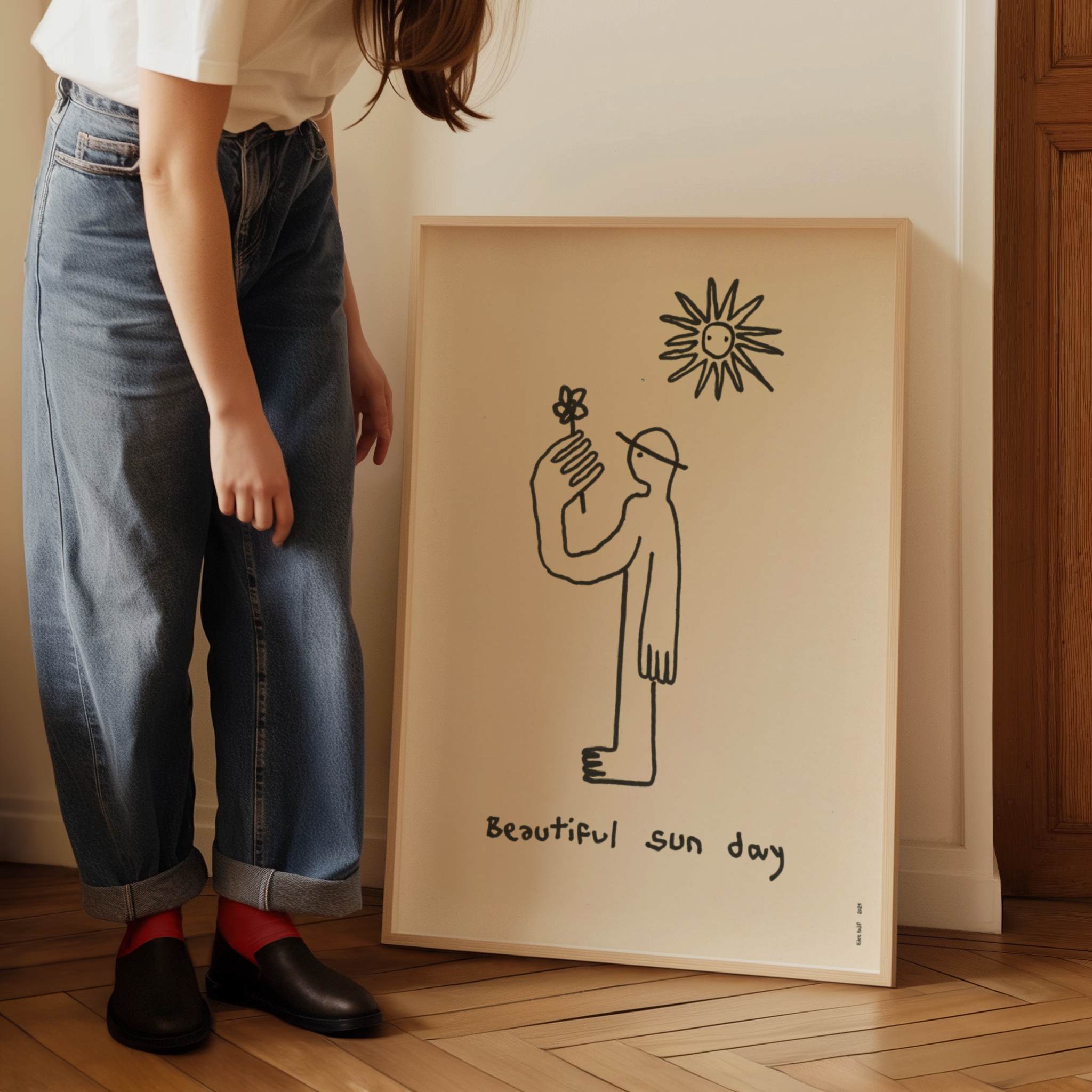
Balance also exists beyond the wall. Furniture, objects, and even empty space all contribute to how a print is perceived. A poster leaning casually against a wall can feel more grounded than one precisely centered above a sofa depending on what surrounds it.

And then there’s the balance between intention and ease. A space should feel considered, but never forced. Styled, but not staged.
Bringing It Together
When color, form, and balance align, something shifts. A room stops feeling decorated and starts feeling composed.
This doesn’t happen all at once. It’s a process of adjustment - moving a frame slightly to the left, swapping one print for another, noticing how the light hits at different hours. Living with the space, rather than finalizing it.

Because the most compelling interiors aren’t designed in a single moment. They evolve. They respond. They reflect.
And in that sense, print design isn’t just about what you hang on your walls - it’s about how you choose to see.
Step into the world of Studio Mottos and transform your walls into entirely new realms. With just a few thoughtful touches, you can create a striking impact that reflects your style and spirit.
Explore the collection, get inspired, and let your space tell a story that feels uniquely yours.